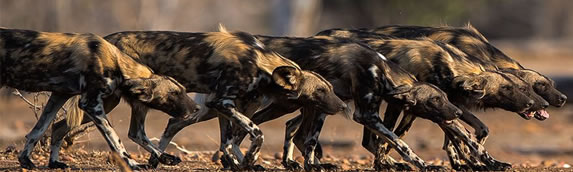
African
wild dogs are highly social carnivores that live in packs. Differences
in the degree of sociality between wild dogs and
wolves (distant cousins of wild dogs) are reflected in a number
of ways. One is in resting patterns in which wild dogs maintain physical
contact or relatively short distances between individuals. Also, unlike
wolves, they typically disperse in groups. Lone dogs and peripheral
pack members are extremely rare. Pack living is obligatory. Compared
to wolves, aggression is generally muted. A high degree of cooperation
is key to survival and reproduction.
Pack
formation in wild dogs is a social process that usually involves more
than two individuals. Although this formation affects both individual
fitness and population dynamics, and therefore is highly relevant to
the conservation of this endangered species, little is known about the
process in the wild and the proximate mechanisms that influence outcomes.
Typically same-sex
relatives emigrate and join opposite-sex groups. Our observations
in the field suggest that group compatibility can influence whether
stable reproductive units form. When opposite-sex groups join, they
undergo what has been termed a "trial courtship" that may
or may not result in the formation of a stable reproductive unit.
If a new pack does not stay together, it annuls. Any given instance
of pack annulment may be due to one or more causal factors that vary
both temporally and regionally. An analysis of resting patterns suggests
that spatial relationships mirror the relative strength of social
bonds and thus the degree of social integration between females and
males. In newly formed packs, same-sex associations were more common
in those that eventually annulled, suggesting that opposite-sex members
were incompatible.
A pack consists of any group of wild dogs with a potentially reproductive
pair. Packs are typically composed of related females, related males,
and pups. If a pack contains more than two adults, the reproductive
pair consists of the dominant male and female. Usually only the dominant
pair breeds and subordinate members help care for pups. The breeding
female selects a den site, such as an abandon aardvark hole, and then
contours the underground chamber prior to giving birth. The average
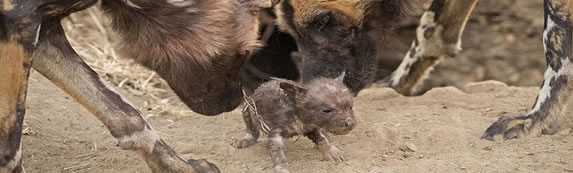
litter size is about 8 pups. When pups are about
three weeks old, they appear above ground pug-nosed with black and white
coloration, and small ears that readily develop into oversized proportions.
Yellow markings begin to appear at four weeks. Babysitters keep a close
eye on them while other family members hunt and return to the den to
regurgitate food. Pups are moved to different dens during the season.
When pups are around 10–12 weeks old, packs resume their nomadic
way of life. By the time the pups are about 4 months, they are already
familiar with what is expected as pack members.
Although
wild dogs will sometimes hunt at night during certain phases of the
moon, they usually rest during the heat of the day and hunt in the early
morning and evening. The fact they are one of Africa's most successful
hunters is due largely to their high degree of cooperation. When chasing
down prey they can run up to 60 km/h. In more enclosed habitats, packs
tend to split into hunting groups, with single dogs often taking down
prey before leaving it to bring back other pack members to feed. Pups
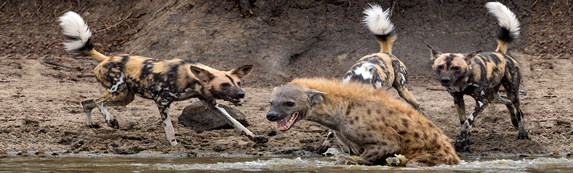
are the first to eat. Prey preferences vary regionally. Spotted hyenas
sometimes follow wild dogs on hunts and try to steal their kill.
Vocalizations
provide a useful window on larger patterns of behavior in social species.
Its study, in the case of African wild dogs, however, has lagged behind
other scientific concerns. Wild dogs have been classified among the
most social of all canids.
One important way this is expresed is in the variety of sounds they
make while interacting, some of which are unique. Its repertoire is
also one of the most complex in Canidae.
Short-range vocalizations accompany many group interactions and appear
to play an important role in the formation and maintenance of bonds.
Vocal and social complexity is also displayed in the mixing of different
sound types to convey ambivalence.
Preceding
a hunt, pack members typically rally in at least one greeting ceremony
before setting off. It usually begins with a single dog running up to
one or more dogs with head held shoulder height, mouth agape, and ears
folded back, often while whimpering or whining. During a high-intensity
ceremony many other
different kinds of sounds are made, including squeals and high-pitched
bird-like sounds called "twitters."
When filtering
through thick bush pursuing prey, pack members often become separated
and sometimes call to reunite. These short repetitive contact calls
or "hoos"
are low-pitched and delivered with the head held lower than the shoulders,
frequently while running. In contrast, wolf contact howls are mostly
long unbroken streams sent with the muzzle held high when standing
still.
|